


 नवीनतम
New study offers clues to mystery behind extreme heat of Sun’s Corona
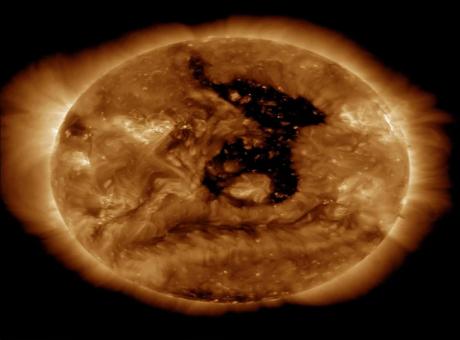
NEW DELHI [Maha Media]:Scientists from Aryabhatta Research Institute of Observational Sciences (ARIES) Nainital, an autonomous institute of the Department of Science and Technology (DST), and Indian Institute of Technology (IIT) Delhi have developed a new method to detect hidden turbulence in the Sun’s outer atmosphere, or corona, potentially helping solve one of solar physics’ biggest mysteries – why the corona is far hotter than the Sun’s visible surface.
The study, recently published in The Astrophysical Journal, used advanced three-dimensional magnetohydrodynamic (MHD) simulations and forward modelling to examine how waves moving through the Sun’s magnetic structures influence plasma behaviour in the corona.
The Sun’s corona is filled with magnetic structures through which propagating transverse MHD waves – commonly known as Alfvénic or kink waves – constantly travel. These waves cause coronal structures to sway sideways as they move outward along magnetic field lines.
Traditionally, scientists believed such transverse waves mainly produced alternating red and blue Doppler shifts, which indicate plasma moving toward and away from observers. However, their possible role in altering the shape of coronal spectral lines had not been clearly established.
Previous observations had detected frequent blueward asymmetries in solar spectral lines, which were generally interpreted as evidence of upward plasma flows, jets, or mass motion along magnetic fields. Since transverse waves are considered nearly incompressible, they were not expected to create significant asymmetries in spectral profiles.
The new study challenges that assumption.
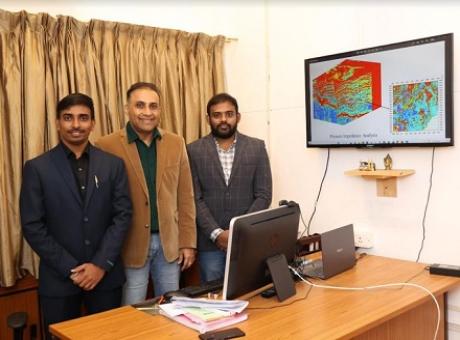
Researchers Ambika Saxena and Vaibhav Pant simulated an open-field coronal region containing density variations across its magnetic structure. They introduced transverse waves at the lower boundary and tracked how the waves propagated upward through the structured magnetic field.
Using forward modelling techniques, the team calculated how plasma emissions would appear in the coronal spectral line Fe XIII 10749 Å.
The simulations revealed that as transverse waves travel through structured magnetic plumes, the plasma does not move uniformly. Density variations within the structure, combined with a process known as phase mixing, create increasingly fine-scale structures and turbulence inside the magnetic field.
Because the solar corona is optically thin, emissions from multiple regions overlap along the observer’s line of sight. Since different parts of the structure move at different velocities simultaneously, the combined spectral signal becomes asymmetric rather than perfectly balanced.
The study found that these wave-driven dynamics naturally generate alternating red and blue asymmetries in spectral lines, with the pattern changing over time and height as the waves propagate through the corona.
Researchers observed that the simulated asymmetries could reach up to 20 percent of the line peak intensity, while secondary plasma velocities ranged between 30 and 40 kilometres per second. The alternating red-blue patterns were also found to travel outward at speeds matching the waves themselves.
According to the researchers, the findings demonstrate that propagating transverse MHD waves alone can create systematic spectral asymmetries without requiring large-scale plasma flows or jets.
Scientists believe the discovery could provide a powerful new diagnostic tool for studying turbulence and wave-driven heating in the solar corona, bringing researchers closer to understanding why the corona reaches temperatures of millions of degrees — far hotter than the Sun’s visible surface.
The study also highlights the potential of advanced observational facilities such as the Daniel K. Inouye Solar Telescope to directly observe these wave-driven spectral signatures in the near future.